The Netherlands Opera’s production of William Tell, directed by Pierre Audi, has proved a daunting endeavor, captivating the audience through its colorful treatment of Rossini’s final opera. From the cast of characters on stage and the musicians of the orchestra to the sound, lighting, stage and costume departments, the roughly four-and-a-half-hour event couldn’t have been more stimulating.
Opening with the instantly recognizable overture (think The Lone Ranger theme song and the grim scenes in A Clockwork Orange), the orchestra, conducted by Paolo Carignani, exhibits the first whims of virtuosity drawing the attention to the scene taking place in the background, a haunting foreshadowing of William Tell’s dreaded future amidst a backdrop of misty waters and stormy landscapes. A mournful cello sets the scene with wailing glissandi and voluptuous vibrato. The despair draws to an end only as a storm breaks on the horizon, as we hear the strings swell with a hyperbolic wave of tremolos passed throughout the section. A soothing English horn and an optimistic flute break the tension of the storm in the Ranz des Vaches, a call to the dairy cows, and the final “cavalry” charge perks up the ears as the percussion can be seen in a visual display of their valiant efforts.


At this point the lustrous work of architect George Tsypin and set and light designer Jean Kalman is on display. The representation of a ship suspended above the stage marks the entire atmosphere, revolving around a community of fishermen. At the top right corner hanging high above it all is a gemstone made from agate, with a cow glancing into its reflection which pops out from the other side. The surrealist design begs one to ponder whether or not we are seeing things clearly, if perhaps our world onstage exists below the waters; it is indeed a direct challenge to the spacial dynamic.
The love story between Arnold and Mathilde is, personally, not so affecting in its believability – but the delivery of the American tenor John Osborn certainly is. Tormented by his love of country and his love for a woman in the ranks of his enemy makes him the most conflicted of the characters in the opera, and thus the most interesting. His consistent and heart-jerking solos in the final act are some of the most memorable in the entire work, hitting high Cs one after the other like clockwork.
The chorus of the Netherlands Opera is considered one of the highest quality in all of Europe at the moment. The musical and physical demands on the ensemble were gracefully and ingeniously balanced through the efforts of each member, of course, but also in the movement conceptions of choreographer Kim Brandstrup. Depicting the struggle of Switzerland in its efforts to regain independence and freedom from its oppressors, the Austrian Hapsburgs, required several large groups of mass choruses (from opposing factions) and ballet dancers, and the incorporation the main characters into these scenes.
One of the most impressive of these mass numbers fell in the third act, which depicts a reluctant Swiss population being forced to submit to the customs and loyalty to the Hapsburgs’ occupation of their land. Roughly 100 people were on stage from the chorus, dancers and actors. The scene itself showed the sophisticated, well-clad Austrians forcing each couple to dance in the typical cosmopolitan style. Cabaret-esque ladies in black corsets cracking dainty whips led the entire procedure which continued on to the delight of those in power and the obvious humiliating submission of the townsfolk.

Nicola Alaimo’s valiant portrayal of William Tell comes to the fore in the famous scene in which Tell must shoot an arrow through an apple atop his son’s head, as ordered from the malicious tyrant Gesler. Though succeeding due to his unyielding marksmanship, Tell is seized anyway by Gesler’s men when the latter discovers a second arrow to be used in the event he should kill his own son and seek vengeance.
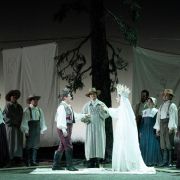
In the end we get what we crave. Arnold leads his countrymen to stand up to their oppressors, meanwhile freeing the captive William Tell. Mathilde defies her own people in lieu of her true love, taking pity and protection over the Swiss women as their men go off to fight. A final stirring of emotions is swept onstage, as the entire cast assembles to face the audience and three simple rays of light cast a sunlit glow on the cause for freedom. Our suppressed heroes are victorious.
One can’t decide whether it’s impressive or somehow suspicious to see such a lengthy production being undertaken with such financial cutbacks from the Dutch government concerning matters of the arts. However, it sends a message. Opera in the Netherlands will not be halted any time soon. From the physical creation of the mystical stage design and subtle lighting techniques to the virtuosic and world-class level of musicianship displayed by the vocalists, chorus and orchestra, there is no doubt that the Netherlands Opera stands as one of the country’s brightest lights in a time of current artistic hardships.