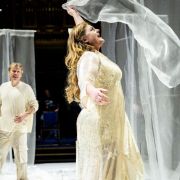
There is usually a good reason why operas which lie unperformed for many years do so – some flaw in the plotting, characters who fail to interest an audience, or musical langueurs. It was therefore with somewhat low expectations that I went to Hampstead Garden Opera’s production of Vaughan Williams’ Hugh the Drover. Imagine my surprise and delight. This was a total joy! Firstly we were looking at a set, designed by Charlie Tymms, conjuring up the image of a Cotswold village in 1810 with a clever sense of perspective suggesting houses on a hill. Everything about the set and costume design was intended to clarify the time and place rather than, as in so many cases, to mystify. The music was immediately accessible, drawing extensively on English folk tunes and Oliver-John Ruthven’s cut-down score made an excellent chamber version. It was played by the Dionysus Ensemble, which Ruthven conducted with verve and sensitivity. Not knowing the original, it is impossible for me to compare it, but this version provided much richness and colour without ever over-powering the singers.


The director, Angela Hardcastle, gave us a lively, pacy production in keeping with Vaughan Williams’ idea of a “ballad opera” and brought out both the work’s beauty and its humour. She had a strong cast to work with. Zachary Devin, who I remember seemed somewhat lacking in gravitas when he played Jove in Hampstead Garden Opera’s Semele, gave us a splendid Hugh. The youth and free spirit inherent in Hugh's character is reflected in the sweet lyric quality of Zachary’s tenor voice which embraces the high notes with ease. He was well matched with soprano Philippa Murray, as a pure-voiced Mary. The two were heard to great effect in their final rhapsodic duet. Of the supporting roles, Charlotte King as Mary’s Aunt Jane sang with a rich mezzo, if with somewhat overly dark vowels, and was particularly moving as she begged Mary to stay. David Roberts made up for any vocal weakness in his relish of the saturnine character of John the Butcher, James Williams as both the Showman and the Sergeant delighted with the clarity of his diction, and Ian Helm as Mary’s father the Constable sang with a full, strong baritone. Nick Whitfield as the Turnkey and Robert Davis as the Ballad Seller in the two smaller roles acquitted themselves well.


The real star of the evening, however, was the ensemble. Each member was motivated throughout and together they produced a full and energetic sound, with even the occasional solo line delivered confidently and with commitment. Dramatically, the crowd displayed typical sheep-like psychosis, one moment happily welcoming Hugh the Drover and the next, at John the Butcher’s instigation, accusing him of being a French spy – a reminder in our own equally volatile times of the power of the masses!
There was a bittersweetness to the finale, with Mary going off happily with Hugh, leaving Father, Aunt and the Villagers facing a sadder future without them. Altogether a most satisfying evening.