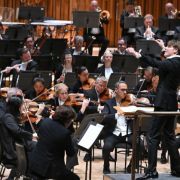
On a stiflingly hot evening, a packed Colston Hall was met with an energetic conductor, Vladimir Ashkenazy, springing to the middle of the stage. Before the audience hushed, Berlioz’s Overture to Béatrice et Bénédict swirled around the room. Light-hearted, breezy and full of optimism, it made a great opening piece to the night’s programme. Béatrice et Bénédict, an ‘opera-comique’, was Berlioz’s last opera, inspired by Shakespeare’s play Much Ado about Nothing.
The programme gave a selection of musical emotions, and Ashkenazy stood at the epicentre. He led the Philharmonia Orchestra through programme and brought life to all the music. Not only is Russian-born Vladimir Ashkenazy an incredible conductor, he also has a successful career as a pianist. Conducting has been his main musical direction over the past twenty years, but this is only a patch on his total musical career, as he first came to prominence on the world stage in 1955. On stage in Bristol, he demonstrated control over the orchestra and a unique understanding of the texture of the music, enabling him to draw out main melodies from anywhere in the orchestra.


It has rarely happened that a musician has given a performance that has ended my attempts to keep my notes flowing, for fear of missing a single moment. Nobuyuki Tsujii was that musician. Blind since birth, his heightened awareness for sound made the quality of his performance sensitive and emotional. Not only was the sound beautiful, but he was absolutely fascinating to watch. On the piano he comes across as natural and is so physically involved in the music. To find the keys, he worked from the edge of the piano, feeling his way into the correct position. Tsujii, Ashkenazy and the Philharmonia performed Frédéric Chopin’s Piano Concerto no. 1 in E minor to huge applause – so much so that Tsujii went off stage and returned to bow three times, guided by the shoulders of Ashkenazy. The audience didn’t stop clapping until he sat down to give the most wonderful encore of a Chopin piece for solo piano. At only 23 years old, having been brought to fame in 2009 at a piano competition, there is almost no doubt that Nobuyuki Tsujii has a huge musical career ahead of him.
After the interval, the Philharmonia performed Berlioz’s Symphonie Fantastique. The large-scale work in five movements is a programmatic piece based on the story of a musician who is hopelessly in love and poisons himself with opium. The drug plunges him into a deep sleep and he experiences strange visions, which are transformed into musical ideas. The work contains an idée fixe: the theme of the woman he is in love with, and this recurs in different forms throughout the work. The Philharmonia is known for its quality of playing and its relationships with the classical music world’s most sought-after performers. They are a modest orchestra who are capable of providing a faultless performance with heart and following direction concisely. The Symphonie Fantastique has all sorts of orchestral textures, from soaring melodies of the lover’s theme to punctuating crashes on the symbols. The fifth movement was particularly breathtaking, where the story loses itself to ghouls and visions and the main theme becomes warped and crude. An optimistic start and an emotional middle were met with a climactic ending, which triumphantly concluded a great night.