Claude Debussy’s only opera, Pelléas et Mélisande, calls for a spring in a forest, scenes in a palace, a well in a park and a scene in the palace vaults. Ever since its premiere in 1902, it has been a difficult work to stage, and indeed to appreciate. Its complex symbolism, impressionistic music and lack of any memorable melodies were not a good recipe for a runaway hit. One hundred and ten years later, it has established itself solidly in the repertoire, and the current production at Barcelona’s marvelous Gran Teatre del Liceu combines the opera with stunning direction from Robert Wilson. It is a co-production with the Opéra National de Paris and the Salzburg Festival.
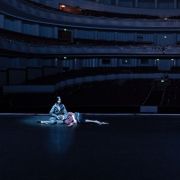
Wilson disposes of any hint of realism and presents the opera in an impressionistic black, white and blue coloration that is simply stunning. He avoids almost completely the use of props. The characters move in a fashion that appears robotic or balletic at times; at other times they seem to resemble marionettes with their arms raised to the side or towards the front of their bodies. Physical contact is almost non-existent and eye contact is avoided almost entirely. In the opening scene, for example, when Golaud (Laurent Naouri) meets Mélisande (Maria Bayo) in the forest and she comments about his hair, she has in fact not looked at him at all. Mélisande does not have long hair, Golaud does not have a sword, and the springs and wells do not appear. All is suggested rather than stated.


Wilson relies on the choreographed movements of the characters and astute and judicious use of lighting to produce this enormously effective version of the opera. The usually empty stage is lit by the changing colours of the background from bright white to various shades of blue.
Mélisande, sung by Maria Bayo, is fragile, mysterious, a bit cunning perhaps, with a soft and affecting voice. She made an outstanding Mélisande from her first appearance as a frightened and perhaps abused young woman to the mother who dies and steps into the light of apotheosis – another brilliant effect by Wilson.
Baritone Jean-Sébastien Bou provided the light voice and style suited to Pelléas. He is the lover who does not utter the word “love” until the very end in this unusual opera, and he is highly effective in the role. Baritone Laurent Naouri was the brooding Golaud, the man who marries Mélisande and subsequently loses her to Pelléas. His dark tones were eminently suited to the role. Soubrette soprano Olatz Saitua with her bright tones made an ideal Yniold, Gonaud’s young son. Contralto Hilary Summers acted and sang well as Geneviève.
Bass John Tomlinson had the role of the old, almost blind King Arkel. Tomlinson at his best has a resonant voice but he delivered some wobbly notes on opening night. They may be suitable to an old man but I am not sure they were entirely intentional and they sounded more like the notes of an old singer. In any event, Tomlinson’s voice is not suitable for the type of music and singing that Debussy’s opera requires. His style is better suited to Wagnerian roles or parts requiring long legato phrases, such as are not present in this opera. At 65, he is well past his prime and this was not his best performance.


Michael Boder conducted the Symphony Orchestra and Chorus of the Gran Teatre del Liceu in an exemplary performance of Debussy’s nuanced score. From conception to execution, however, this production owes most of its strength to the genius of Robert Wilson, who delivers a taut, original and stunning interpretation of the work.